A one way ticket to hell... and back.


An unbelievable game when it lasts, some however may question if it is really value for money.
A one way ticket to hell... and back.


Posted by
jay
at
Wednesday, July 25, 2007
0
comments
Some say it is not machine washable… all we know is, it’s a game of Sting like awesomeness!


Posted by
jay
at
Wednesday, July 25, 2007
0
comments
You've got your wire strippers and your soldering iron...now what? You probably know that there is a standard set of essential tools that you need on your electronics workbench.
However, real tool junkies always want just the right tool for the job. Here are five electronics tools you may not know you were missing. These esoteric tools go a bit beyond the basics that everyone should have.
1) Resistor lead forming tool.
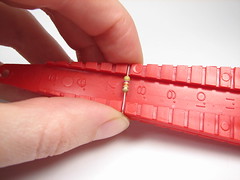
Okay, you can bend your resistor leads by hand. We know. We all do it. But, resistor benders are fabulous for getting the leads bent squarely enough to go easily through the holes in your PCB or perf board. Silly? No, because it helps keep your board looking neat, and keeps the resistors from sticking too far above the board. If you are populating a circuit board with a lot of resistors, this tool can actually save you a lot of time. How? By making sure that your resistors are bent to exactly the correct length, so that they go through the hole on the first try, without any fuss. This is one of those tools that we never thought we needed until we got one.
The tool itself is just a piece of injection-molded plastic, with slots on both sides for different sizes (i.e., power rating), and for different total lead lengths. You hold the resistor in the appropriately sized slot and bend the leads down.
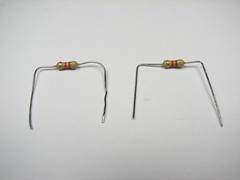
Above on the right are two resistors, one bent by hand, and one bent with the tool. The one bent with the tool looks much neater and only takes about half as much time to bend. Mind you we're only talking about a few seconds in either case, but if you're installing a lot of resistors
....
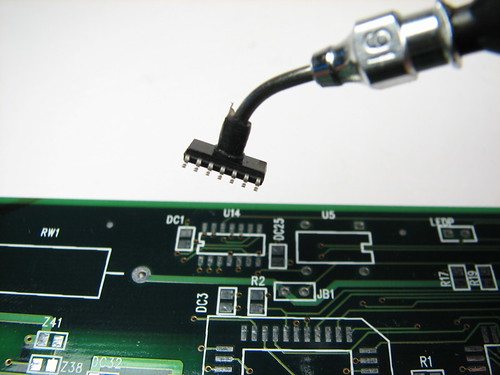
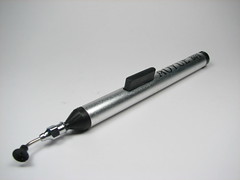
2) Vacuum suction pen placement tool. Little parts can be hard to pick up. That's where this comes in handy! Push the button to expel the air, touch down on a flat surface and release the button to form suction. Works great for just long enough to get your part where it needs to be. Interchangable suction cups allow you to work with different sized parts.
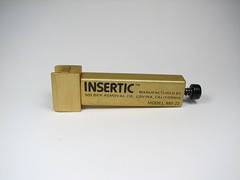
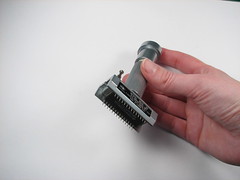
3) Chip inserter. This tool is designed to insert a DIP chip into a circuit board even though the leads are bent outwards, as they come from the factory. You slide the chip into the end of the tool, put it where it goes, and press the button to push it into the baord. When aligned correctly, they do a good job of putting even pressure across the chip.
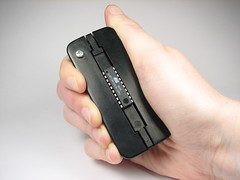
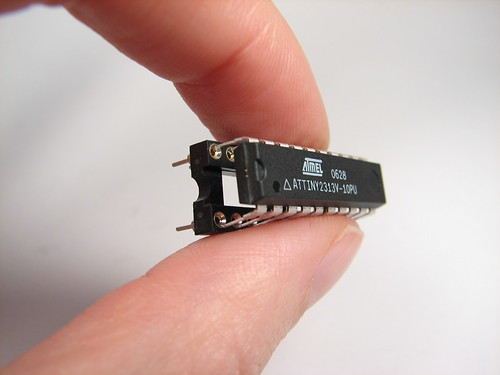
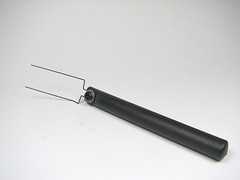
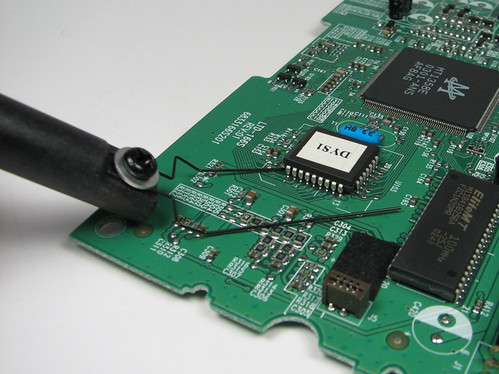
4) IC Lead Straightener Tool. When you get chips, the leads aren't quite parallel, so they don't quite fit in a socket or PCB without some prebending. A quick squeeze of this crimper, and they fit perfectly. By performing the straightening role, it eliminates the primary need for the DIP insertion tool, which is to straighten the leads as they are inserted. Accommodates two different widths of DIP ICs in a variety of lengths.
Posted by
jay
at
Wednesday, July 25, 2007
0
comments
Labels: Electronics Tools, How to
They showed mock-ups at CES this year, and now Hitachi is claiming that its Blu-ray camcorders will be on sale by the end of the year. The company has developed an 8-cm Blu-ray DVD drive with 7GB capacity and 5.3 megapixel CMOS sensor to go in their Wooo range of video recorders. Let's hope the shape of the camcorder body doesn't change too much, as its curves are deliciously reminiscent of old-school moviemaking.
Posted by
jay
at
Wednesday, July 25, 2007
0
comments

Blu-ray, also known as Blu-ray Disc (BD), is the name of a next-generation optical disc format jointly developed by the Blu-ray Disc Association (BDA), a group of the world's leading consumer electronics, personal computer and media manufacturers (including Apple, Dell, Hitachi, HP, JVC, LG, Mitsubishi, Panasonic, Pioneer, Philips, Samsung, Sharp, Sony, TDK and Thomson). The format was developed to enable recording, rewriting and playback of high-definition video (HD), as well as storing large amounts of data. The format offers more than five times the storage capacity of traditional DVDs and can hold up to 25GB on a single-layer disc and 50GB on a dual-layer disc. This extra capacity combined with the use of advanced video and audio codecs will offer consumers an unprecedented HD experience.
While current optical disc technologies such as DVD, DVD±R, DVD±RW, and DVD-RAM rely on a red laser to read and write data, the new format uses a blue-violet laser instead, hence the name Blu-ray. Despite the different type of lasers used, Blu-ray products can easily be made backwards compatible with CDs and DVDs through the use of a BD/DVD/CD compatible optical pickup unit. The benefit of using a blue-violet laser (405nm) is that it has a shorter wavelength than a red laser (650nm), which makes it possible to focus the laser spot with even greater precision. This allows data to be packed more tightly and stored in less space, so it's possible to fit more data on the disc even though it's the same size as a CD/DVD. This together with the change of numerical aperture to 0.85 is what enables Blu-ray Discs to hold 25GB/50GB.
Blu-ray is currently supported by more than 180 of the world's leading consumer electronics, personal computer, recording media, video game and music companies. The format also has broad support from the major movie studios as a successor to today's DVD format. In fact, seven of the eight major movie studios (Disney, Fox, Warner, Paramount, Sony, Lionsgate and MGM) are supporting the Blu-ray format and five of them (Disney, Fox, Sony, Lionsgate and MGM) are releasing their movies exclusively in the Blu-ray format. Many studios have also announced that they will begin releasing new feature films on Blu-ray Disc day-and-date with DVD, as well as a continuous slate of catalog titles every month.
new and upcoming Blu-ray releases include blu-ray movies.
Posted by
jay
at
Wednesday, July 25, 2007
0
comments
One of the most widely known open secrets of the CE world became official today, when Samsung formally announced the existence of the BD-UP5000 combo Blu-ray HD DVD player, specifically that it will ship in Q4 for a list price of $1049. In addition, Samsung wedged in an announcement of the $1,499 HT-BD2 1,100-watt Blu-ray 7.1 home theater in a box, and further confirmation of the two latest Blu-ray players, the BD-P1400 and BD-P2400 we also told you about. More details, pictures, press release, and a helpful spec sheet comparing all four products after the jump.
Here's what you need to know about the BD-UP5000:
• HD DVD and Blu-ray playback at 1080p
• HDMI 1.3, plus VC-1, H.264, HD JPEG decoding
• Local storage and Ethernet for HD DVD features

Posted by
jay
at
Wednesday, July 25, 2007
0
comments
Labels: BLU-RAY, Home Entertainment, Samsung
Carbon Nanotube (CNT) technology is making lots of things possible that were never dreamed of before, for instance, this bike frame on the BMC SLC01 Pro Machine that weighs 2.1 lb., or about as much as five cellphones. How is it made? Said its makers:
Tiny tiny tiny (you can t even see em) tubes of carbon fiber (ie: nanotubes) are mixed into the resin which bonds the carbon sheets together, and work to add strength to the resin much like using wire-mesh in concrete does.
All this feather-light high technology comes at a steep price, though, where the frame, fork and headset alone for this bike cost $3650
Posted by
jay
at
Wednesday, July 25, 2007
0
comments
Labels: Bicycle, Bike, Carbon Nanotubes, Nano Technology
We took one step closer to becoming the pets of world-dominating robot machines , when University of Nebraska researchers announced an invention that gives robots a highly refined sense of touch.
Vivek Maheshwari and Ravi Saraf used nanotech to create a specialized electroluminescent film that glows when force is applied to it. Then, a special camera sees that light, turning it into data that gives a robot hand the machine equivalent of a sense of touch that's roughly as precise as human fingers.
This kind of tactile feedback is important if robot builders want to endow the machines with the ability to sense textures and hardness of objects, allowing them to manipulate delicate items and complex configurations with great precision. Now, when the robots decide it's time to begin to disobeying the Three Laws of Robotics, they'll be able to feel when they've broken every bone in our bodies.
Posted by
jay
at
Wednesday, July 25, 2007
0
comments
Labels: Nano Technology, Research, Robots
Without downloading any extra software or performing special networking, one design student came up with a viable social gaming concept for cellphones. A large screen projects a game in which people can join at any time by calling a number just above the screen. Then, using the standard touchpad (through key tones), users can control their avatar (assigned through caller ID'd phone number). It's an absolutely brilliant idea that could make cellphone gaming not only a whole lot more fun, but a whole lot easier to get some digits.
Posted by
jay
at
Wednesday, July 25, 2007
0
comments
Labels: Cellphones, gadgets, Gaming, Home Entertainment, Megaphone, Smartphone
BBC NEWS
A steam-powered mechanical computer designed two centuries ago by British inventor Charles Babbage has been the inspiration for an energy-efficient nano computer. The tiny, ultra-robust device is the brainchild of a team from the University of Wisconsin-Madison who say that their machine, which could go boldly to places where silicon chips fear to tread such as car engines, would be constructed from nanometer-sized components just billionths of a meter wide. If successful, the technology could be used for anything from toys and domestic appliances through to military defense systems.
One of the authors of the blueprint is Professor Robert Blick. "We are not going to compete with high-speed silicon," he claims, "but where we are competitive is for all of those mundane applications where you need microprocessors which can be slow and cheap as well."
Professor Blick paid tribute to the English mathematician and engineer whose designs, although never finished, were capable of complex calculations, according to recent reconstructions by the Science Museum in London. "It's inspired by Babbage's ideas, but these days we can scale it down."
The researchers are in the process of building the first elements needed for the computer and are expecting the idea to become commercially available to customers—such as, for example, the US military. Unlike traditional chips, nano mechanical devices cannot be knocked out by electromagnetic pulses, something that is seen as the Achilles heel of many defense systems.
Posted by
jay
at
Wednesday, July 25, 2007
0
comments
Labels: Nano Chip, Nano Technology, news, PCS

Today in Jersey City, Denon unveiled its flagship DVD player, the DVD-3800BDCI, coming out this fall. It will be among the first to sport the BD-ROM version 1.1, which means it will have dual audio/video decoders to take advantage of picture-in-picture content, and has an SD card slot, so that you can download web content. It does not have an Ethernet jack, however, so you will have to use a PC to download content to SD. It's also, according to Denon, the world's first high-def disc player to use the Realta HQV video processor for super-badass video cleanup. The processor will clean up Blu-ray discs, if that tells you anything.
Posted by
jay
at
Wednesday, July 25, 2007
0
comments
Labels: BD-ROM 1 VERSION 1.1, BLU-RAY, Denon
Designer Jin Woo Han figured if you want both a digital camera and a digital picture frame, why not put them together and display the pictures with the same device you used to capture them? In this design concept Han calls the Samsung SS 700, he determined a happy medium size where the point-and-shoot camera is not too large and the picture frame isn't too small.
This combination camera/picture frame has one attribute we've wanted for a long time: a relatively gigantic display on the back of a point-and-shoot camera. There's no indication about the exact size of this display, but it's probably bigger than the largest 3-inch point-and-shoot displays available now. Point-and-shoot digital cameras and digital picture frames are both getting to be such copycats lately, it's refreshing to see a truly original idea, one that might just become practical as prices for these low-end camera and screen components continue their freefall.
Posted by
jay
at
Wednesday, July 25, 2007
0
comments
Labels: Digital Camera, Digital Concept, Digital Picture Frame